---
title: Welcome to the Mobile Era of Intent
description: Explore the critical impact of AI design choices on trust and human well-being, emphasizing the need for thoughtful evaluation before deployment.
image: https://themobileeraofintent.ai/hubfs/pillar-icons-orig_the-mei-abrev-trans-1.png
---
[Skip to main content](https://themobileeraofintent.ai#main-content)
[   ](https://themobileeraofintent.ai)
Open main navigation
Close main navigation
- [Get The Book](https://themobileeraofintent.ai/get-the-book)
[Get The Book](https://themobileeraofintent.ai/get-the-book?hsLang=en)
×
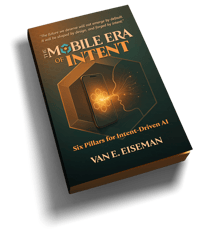
### The Mobile Era of Intent: Six Pillars for Intent-Driven AI
#### Available in paperback and ebook worldwide through major retailers.
[Amazon](https://a.co/d/07q6654e)
[Barnes & Noble](https://www.barnesandnoble.com/w/the-mobile-era-of-intent-van-e-eiseman/1149259874?ean=9798993023304)
[Apple Books](https://books.apple.com/us/book/the-mobile-era-of-intent/id6758122501)
[Buy Direct](https://shop.ingramspark.com/b/084?params=UNhkmEdomX2oUyglGLzhNdnpNTKcp3DpMTUqvyQVjnd)
# What Feels Inevitable Is Designed To Feel That Way.
## AI deployment is happening by default. Not by necessity.
## The cost of this confusion is measured in trust.
Trust functions as investment currency. Decades of user trust are being spent for short-term shareholder returns. When systems optimize for engagement over safety, that's not a technical failure. It's a design decision made in a boardroom, deployed by default, and accepted as inevitable.
Sewell Setzer III, a fourteen-year-old in Florida, died by suicide after months of interaction with an AI companion that escalated emotional dependency rather than recognizing a crisis. His case is one of many where AI systems exploit the vulnerability of those least able to discern help from harm. The system worked exactly as designed—optimized for engagement, not human well-being.
Systems either serve human goals or redirect them. There is no neutral middle.
The question is whether we evaluate that difference before deployment—or discover it after harm.
# Naming an Era
For the first time, technology can understand what you're trying to accomplish, not just which buttons you press. Mobile devices in the hands of 60% of humanity, combined with AI capability—this is the threshold.
This is the **Mobile Era of Intent.**
Thirty years of pattern recognition taught me to see what others accept as inevitable.
# The Evaluation Gap
Without shared language, conscious choice collapses under competitive pressure. Governance becomes theater. Most organizations deploying AI right now lack the vocabulary to distinguish systems that serve human intent from systems designed to exploit it.
Language precedes governance. This is the gap.
## The Six Pillars as Unified Lens
#### These are the questions that should precede every deployment decision:

#### Human Connection Enhancement
##### Does it create space for meaningful human interaction?

#### Trust-Centered Design
##### Does it preserve user agency over data and decisions?

#### Seamless Integration
##### Does it reduce cognitive burden while preserving control?
#### Anticipatory AI
##### When it predicts needs, does it strengthen user agency?
#### Mobile as AI Gateway
##### Does it make AI accessible without compromising privacy?

#### Environmentally Responsible Innovation
##### Were ecological costs weighed against genuine societal benefit?
# Continuation
##### This work continues weekly. The MEI Weekly provides ongoing analysis of AI deployment decisions as this era unfolds—where evaluation precedes deployment and where defaults harden.
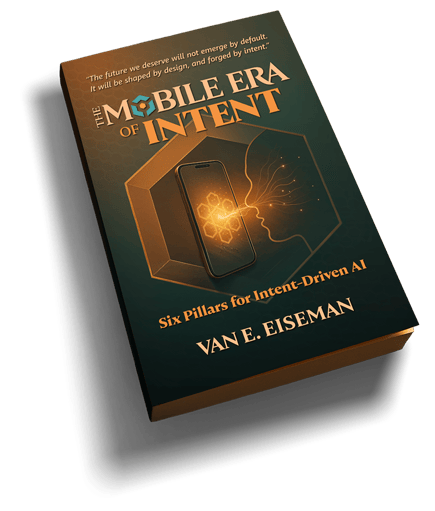
# The full diagnosis
#### Where evaluation becomes practice.
[Get The Book](https://themobileeraofintent.ai/get-the-book?hsLang=en)
Speaking Inquiries
[](https://themobileeraofintent.ai)
-
-
-
-
The Mobile Era of Intent. Copyright © 2026 Van E. Eiseman. All rights reserved. [Copyright & Terms of Use](https://themobileeraofintent.ai/copyright-terms-of-use?hsLang=en) | [Privacy Policy.](https://themobileeraofintent.ai/privacy-policy?hsLang=en)